What Is a Tarot Reading, Actually?
A straightforward answer for the tarot-curious who've never booked one.
If you've never had a tarot reading, here's what you're probably picturing: dim lighting, a woman in a headscarf, a dramatic pause before she flips a card and tells you something ominous about your future. That's a Hollywood invention. Here's what actually happens.
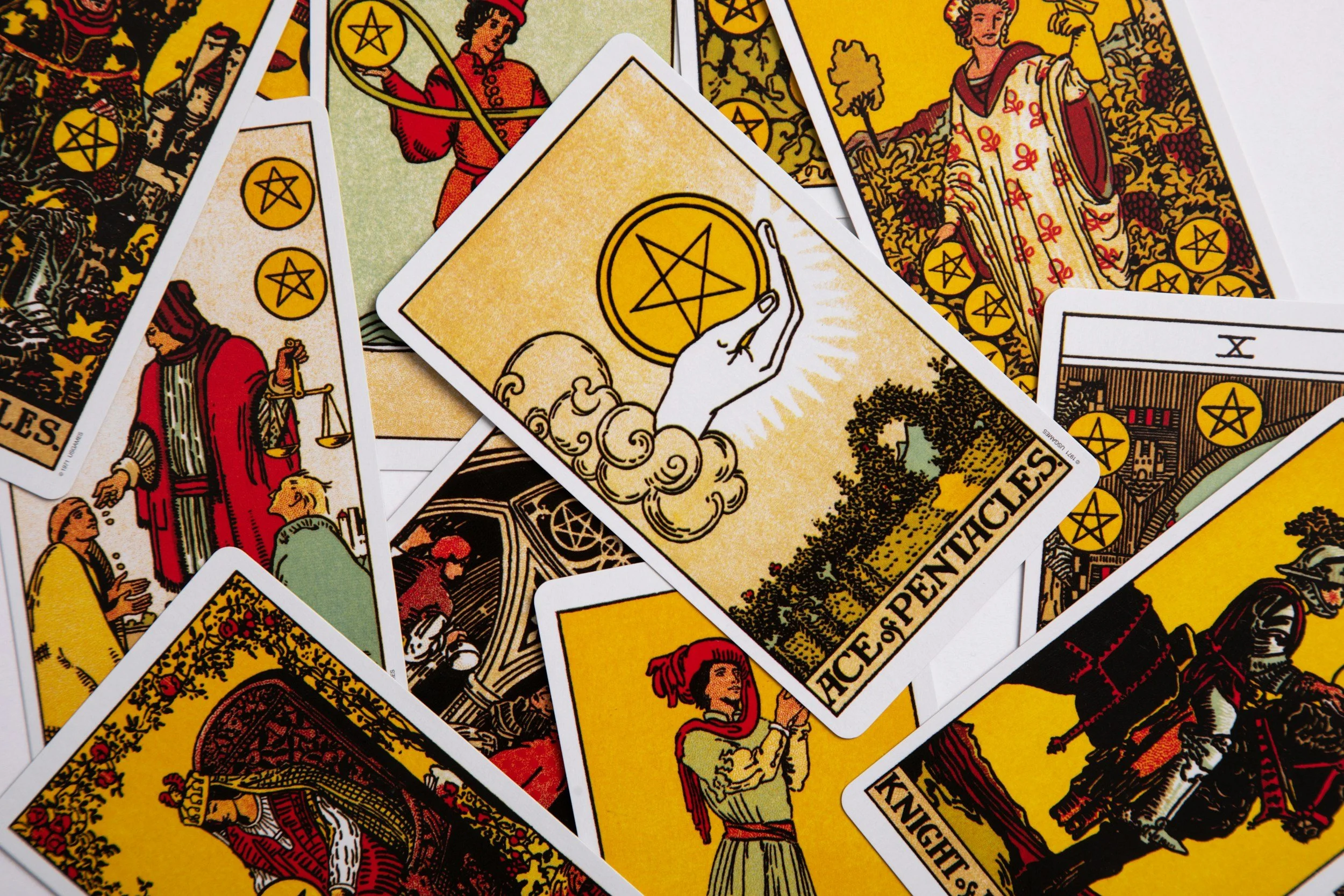
It starts with a question, not a prediction
A tarot reading doesn't begin with "let me tell you your future." It begins with you naming something you're curious about — a decision you're weighing, a season of life you're in, a relationship you want more clarity on. The cards aren't a crystal ball. They're a prompt for reflection, more like a well-designed conversation starter than a fortune-telling device.
You don't need to believe in anything supernatural for this to work. You just need to be willing to think out loud.
The deck, briefly explained
A standard tarot deck has 78 cards, split into two groups:
The Major Arcana (22 cards) represent big, archetypal themes — new beginnings, endings, transformation, choice. These are the cards you'll see most in a quick single-pull format, because they carry a lot of meaning in one image.
The Minor Arcana (56 cards) work more like a regular deck of playing cards, split into four suits, and tend to speak to day-to-day specifics — work, communication, emotion, material concerns.
A full reading usually pulls several cards laid out in a pattern called a spread, each position representing a different angle on your question (where you've been, where you are, where you're headed). A quick single-card pull, on the other hand, is exactly what it sounds like — one card, one question, one focused reflection.
What actually happens during a reading
You share what's on your mind — as specific or as vague as you're comfortable with. A card (or a few) gets pulled. Then comes the actual craft: not a scripted "this card means X," but a conversation about how that card's traditional meaning might connect to what you just shared. A good reading feels less like being told something and more like being asked good questions with a visual prompt in the middle of it.
The goal isn't to reveal something you don't already know. It's to surface something you already sense, and help you see it more clearly.
Why this format works for groups
Because tarot is fundamentally a conversation, it translates surprisingly well to a group setting — a bachelorette weekend, a team offsite, a happy hour. Everyone gets their own individual moment, but there's something genuinely bonding about a group of friends or colleagues comparing notes afterward. That's really the whole idea behind gathering people around this in the first place: connection, not prediction.
Ready to see it for yourself?
If a quick single pull sounds like the easiest way to try this, keep an eye out for us at public events under The Draw. If you're planning something for a group, The Gathering is our most approachable full-session format — an hour, rotating mini-readings, and a shared moment at the end.
